As intimidating as that old Roman law adage sounds, it has a very simple and common sense meaning: No one can transfer more rights to another than he himself has.
Often referred to as the nemo plus iuris rule, it was formulated by one of Rome’s great jurists, Ulpian, and eighteen hundred years later it is still regularly quoted in our modern courts. To take one example, if you don’t own that house you’re selling me, you can’t transfer ownership to me. With only a few exceptions, that remains our law today.
The National Minimum Wage (NMW) for each “ordinary hour worked” has been increased from 1 March 2026 by 5% from R28,79 per hour to R30,23 per hour.
Domestic workers: Assuming a work month of 22 days x 8 hours per day, R30,23 per hour equates to R241,84 per day or R5320,48 per month. Of course, this is just the bare legal minimum. The Living Wage calculator will help you check whether you are actually paying enough to cover a household’s “minimal need” (adjust the “Assumptions” in the calculator to ensure that the figures used are up-to-date).
“Fraud unravels property transactions even where innocent third parties are involved.” (Extract from judgment)
Congratulations, you’re the proud new owner of your dream home! Your name’s on the title deeds, and your ownership is registered in the Deeds Office. That’s conclusive proof that the house is yours, right? Regrettably, this isn’t always the case…
Although registration is usually proof of ownership, there are exceptions. One exception is fraud. And a recent High Court case is a sharp reminder to every party to a property sale and transfer (seller, buyer, estate agent, conveyancer and bonding bank) that any sale and transfer tainted by fraud will almost certainly unravel.
As we shall see, a crooked “conveyancer” was at the heart of this particular saga, so perhaps the most important lesson here is one for sellers. Choose your conveyancer with care!
Many of the facts in this convoluted story were in dispute, but the Court’s decision rested on these findings:
The owner, since 2011, of a house in Bloemfontein lived there with her elderly mother. She signed an agreement in 2020 to sell it for R300k to a trust. The sole trustee’s wife was an attorney, but not a qualified conveyancer. Nevertheless, she was appointed in the sale agreement as the “conveyancer” to attend to the transfer.
Shortly after signing the deed of sale, the owner changed her mind and said she was cancelling the sale. Although her “cancellation” seems to have been accepted by the trust, it was invalid for lack of being recorded in writing and signed. What her attempt at cancellation did prove was that she no longer had any intention of passing transfer to the trust. Moreover, the whole sale agreement fell through when the trust failed to get a bond as required by the bond clause. In the end, the owner received not a cent of the R300k, and presumably she spent the next three years happily confident that the sale had fallen away.
Imagine her shock when in 2023 she received an eviction application from a couple who had, without her knowledge, bought the house from the trust for R480k. Only then did she find out that the trustee and his attorney wife had secretly transferred her house, in consecutive transfers on the same day in 2022, firstly from her to the trust, and then from the trust to the couple. The couple were of course now convinced that the house belonged to them.
Off went our original owner to the High Court, which held that there was no doubt that the husband-and-wife team of trustee and attorney had acted in cahoots to defraud both the original owner and the eventual buyers. It accordingly declared both sales and transfers to be invalid and ordered the house to be re-transferred to the original owner.
At the heart of the Court’s decision lies the old Roman concept of fraus omnia vitiat or “fraud unravels all”. There are some exceptions to the application of this principle in our modern law, but the general rule remains that where a property sale is tainted by fraud, any purported sale or transfer of ownership resulting from it is null and void.
Moreover, one can never pass on to another person more rights than one has. Since the sale to the trust was void, all subsequent sales must also be void regardless of registration of transfer. In any case, the second sale agreement had lapsed, again because of non-fulfilment of a bond clause.
For all those and a variety of other reasons, the original owner had never lost her ownership despite the transfers being registered in the Deeds Office.
The couple who bought the house for R480k must now presumably carry on paying their home loan instalments despite having no asset to show for it, and will be wondering whether they can recover their losses from anyone.
As the Court put it: “Fraud unravels property transactions even where innocent third parties are involved.”
Bottom line is this: Sellers, don’t take chances when choosing your conveyancer!
“Lemon law, noun – a law that states that you can return a motor vehicle to get it repaired or your money back if the vehicle is no good.” (Oxford Learner’s Dictionaries)
The car you just bought on instalment sale turns out to be a complete lemon. But when you return it to the dealership and cancel the sale, the bank still enforces the finance agreement and sues you for damages.
“Sorry to hear about the defects,” says the bank. “But that’s not our problem. We weren’t the supplier; we just financed the transaction. Your claim is against the dealership. You’re still bound by the instalment sale agreement and must cover our losses.”
A motor dealership in Koster (a small farming town in the North West Province) sold a 5-year-old Ford Ranger 3.2 TDCI 4×4 automatic to a mother, who bought it on behalf of her son with bank financing on an instalment sale basis.
All pretty standard stuff… Until, just four days after delivery, the oil cooler and gearbox started giving problems. The son returned it to the dealership, which replaced the gearbox. But then less than two months later, the vehicle overheated. Unsurprisingly the son returned it to the dealership as a dud that he no longer wanted. His mother, as buyer, formally cancelled the agreement with a lawyer’s letter.
The bank sued her for damages, and while it was successful in the High Court, the SCA (Supreme Court of Appeal) reversed that decision and upheld the buyer’s counterclaim for cancellation of the instalment sale and restitution of everything she had paid the bank. The bank must accordingly refund her the deposit and all the instalments she had paid it, together with interest and costs.
That outcome, and the SCA’s reasoning in reaching it, hold important lessons for all suppliers of goods of all kinds (not just vehicles), buyers, and banks.
The buyer’s success hinged on the Court’s findings that:
After this far-reaching decision banks can no longer say “sorry, we just financed the deal, you must sue the seller”. Of course, any banks with differently worded agreements might still be able to argue that they really were nothing more than the finance providers, but banks generally will no doubt take steps now to mitigate this new risk. Perhaps we can expect much tighter lending restrictions or reworded finance agreements? Time alone will tell what they come up with.
For now, though, whether you are suing the seller or the bank to get your money back, your position will be a strong one if you can prove all the above factors.
As a final cautionary note, the Court made it clear that you must act (i.e. cancel the sale and return the goods) within “a reasonable time” after discovering the defects.
So don’t delay. If you find out you bought a lemon and the seller refuses to cancel the sale and refund you, call us immediately.
“We are also proposing additional tax measures to ease the financial burden on households and businesses, by adjusting personal income tax brackets and rebates fully in line with inflation.” (Minister of Finance Enoch Godongwana)
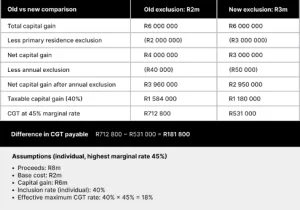
A big highlight for property sellers and buyers is that, having remained unchanged since 2012, the primary residence exclusion for Capital Gains Tax has been increased from R2 million to R3 million. In addition, the annual CGT exclusion has been increased for individuals by 25% from R40,000 to R50,000, and for deceased estates by 47% from R300,000 to R440,000.
The big win is that when you sell your primary residence (the home you live in), the first R3 million capital gain is now excluded from CGT.
Have a look at the illustrative savings calculation below:

Unchanged from last year, you pay no transfer duty if the property you are buying sells for at (or below) the set threshold of R1,210,000.
Individual taxpayers:Your tax rates (and the associated rebates and medical tax credits) are increased in line with inflation. That’s welcome relief after last year’s unchanged tax tables which resulted in “fiscal drag” (also referred to as “bracket creep”) for anyone receiving a salary increase that pushed them into a higher tax bracket.
Trusts: Special trusts are by and large taxed as individuals, but other trusts are taxed at a flat rate of 45% – also unchanged from last year.
Corporate taxes: The tax rate for companies remains unchanged, with substantial relief for smaller businesses.
Most sin tax increases were generally in line with or slightly below inflation. See the table below for full details.
Table 4.8 Changes in specific excise duties, 2026/27
Source: National Treasury (Table 4.8)
Use Fin 24’s Budget Calculator here to find out.
“Trade Mark”
A trade mark is a brand name, slogan or logo that identifies your services or goods and distinguishes it from the goods and services of other businesses.
Registration gives you easily enforceable rights to use or licence the mark, and to stop others from using it (or one that is confusingly similar). Without registration, you must prove another ground for protection, such as “passing off”. Your mark can be protected forever but must be renewed every ten years. Note that trade mark rights are inherently territorial, so local registration doesn’t ensure international protection.
“Sexual harassment is the most heinous conduct that plagues the workplace.” (Extract from the judgment below)
Our courts have no tolerance for sexual harassment in the workplace, stressing that, at its core, it is concerned with power dynamics at work.
A recent Labour Court decision has confirmed that in assessing whether or not an employee is guilty of such harassment, it is the victim’s perspective that must lie at the heart of the enquiry. Victims will take heart from this decision, while employers and other employees should understand clearly the dangers of not heeding it.
A bank manager was found guilty of two counts of gross misconduct in respect of:
These comments were about her hair, clothing and appearance, such as “you are so beautiful”, “you are so stunning”, and “black looks good on you.” Most tellingly perhaps, he suggested that she sit on his lap when he was taking employee temperatures as part of a Covid screening process. All conduct that, she said, upset and offended her.
The manager denied all these allegations but was found guilty and summarily dismissed. He approached the CCMA (Commission for Conciliation, Mediation and Arbitration) where the arbitrator, deciding that the employee was untruthful and that no harassment had been proved, held that the dismissal was substantively unfair and awarded the manager R400k in back pay.
The bank took this decision on review to the Labour Court, which reversed the finding and confirmed the manager’s dismissal.
Let’s have a look at the Court’s reasoning.
In general terms:
The Court in deciding to confirm the manager’s dismissal commented that sexual harassment is heinous conduct. As it goes to the root of one’s being, it must be viewed from the victim’s point of view, how the victim perceived it and whether or not that perception is reasonable.
In this case, held the Court, the employee’s evidence was supported by the probabilities and was more credible than her manager’s version. He was accordingly guilty of the charges of harassment and sexual harassment, his employer could not fairly have been expected to continue the employment relationship with him, and his dismissal was fair.
Victims will take heart from this outcome, and it’s a warning to both employers and other employees to view all workplace conduct from the perspective of those on the receiving end.
Perhaps a good way of looking at it could be this: Might the recipient of a “compliment” or other “innocuous” conduct reasonably construe it as inappropriate and unwelcome? If so, employers have a duty to act, and perpetrators are in trouble.
“Wouldn’t it be nice to get on with me neighbours?” (from “Lazy Sunday” by Small Faces)
Maintaining friendly relations with the neighbours, or at least an “I’ll ignore you if you ignore me” sort of neutrality, has probably been a primary aim of homeowners since the dawn of history. No doubt even our cave dwelling ancestors were as keen to get on with the Joneses next door as they were to keep up with them. But as we all know, it’s not always easy.
A recent High Court fight over parking rights is unfortunately pretty much par for the course when it comes to neighbourly relations deteriorating into open conflict, both inside and out of the courtroom.
The setting for this fight: Higgovale, a small and affluent suburb on the slopes of Table Mountain in Cape Town. In one corner: a couple with the right to access their garage using a servitude road. In the other corner: the neighbours, alleged to have impeded the couple’s garage access by parking in the road.
At the heart of the dispute: the road servitude. Servitudes involve a balancing act between the right of the “dominant owner” to exercise the servitude and the right of the “servient owner” to have the servitude exercised in such a way as to impose the “lightest burden” on their property. The tensions inherent in such a relationship can easily escalate into conflict – exactly what happened here.
The garage-owning couple’s initial stance was to ask the Court for a blanket interdict against all parking by the neighbours in the road, but they later softened that to ask only for an order against their garage access being obstructed.
The Court had no hesitation in ordering that the neighbours “are interdicted and restrained from parking vehicles on the servitude area at … Higgovale, in such a manner as to unreasonably obstruct the applicants from entering and exiting their property and exercising their right of way.”
In doing so, the Court took the parties to task for failing to settle their dispute out of court, and urged them “to engage with each other in a manner that promotes the spirit of ubuntu, and the constitutional vision of a caring society based on good neighbourliness and shared concern” (emphasis supplied), and to consider demarcating parking bays in the road as a short-term solution.
The parties now have to pay their own costs (except for the costs of one interim application), and they’re effectively back to square one: having to engage with each other to try to find a fair solution.
Per the Court (emphasis supplied): “While the common law requires that neighbours act reasonably, the Constitution shows what a reasonable neighbour looks like. She is not only concerned with advancing her own private interests but cares also for the needs of her neighbours. She seeks mutually beneficial solutions. The mindset of the reasonable neighbour is one of collaboration, not competition. She sees herself not as an isolated individual, but a partner in an interdependent community of persons, all of whom are to be respected and valued.”
Courts want us to settle these sorts of disputes in that collaborative spirit, without recourse to law. But if a friendly discussion over a cup of coffee doesn’t resolve the situation, more robust action might be unavoidable – we’re here to help if you need us.
“You know you’re winning when you’re being copied.” (Robin Sharma, author of The Monk Who Sold His Ferrari)
Whether your business is brand new or well established, you need to protect your trading, product and service names from being unlawfully copied. Often your names (and associated logos and other branding) are essential elements in your business’ goodwill and profitability. It can be disastrous if competitors adopt similar branding in order to confuse customers and divert business away from you.
Your strongest protection will always be in the form of a registered trade mark, but don’t despair if you don’t have one – our laws still provide protection through the “passing off” concept.
A recent Supreme Court of Appeal (SCA) judgment provides a perfect example.
The opposing sides in this saga are Fire Logic (Pty) Ltd t/a “Fire Logic”, and Logik Group Africa (Pty) Ltd t/a “Fire Logik” (the company itself was previously Fire Logik (Pty) Ltd). Both operate in the same industry (fire protection and safety systems): Fire Logic since 1994 and Fire Logik since 2015.
In 2021 Fire Logic applied to the High Court to interdict Fire Logik from continuing to trade under that name. Logik Group denied any wrongdoing, but the High Court granted the interdict and the SCA confirmed it on appeal.
To understand that outcome, let’s have a look at the law underlying it.
To succeed in a claim for passing off, you will have to prove three elements:
The core question is a factual one, to be answered in light of all the circumstances of each case: Is there a reasonable likelihood that members of the public may be confused into believing that the business of the one is, or is connected with, that of the other?
A registered trade mark will always be your best and strongest protection, and although registration doesn’t come cheap, the cost could well be justified when you consider the alternative – having to apply to the courts for redress.
If you have no registered trade mark, and must rely on passing off provisions for protection, maximise your chances of success with these tips:
“All you need is love… and a good lawyer.” (Anonymous)
February, with its Valentine’s Day chocolates, roses and declarations of undying love, should be a month for romance, not legal niceties. But in the real world, love and the law are inextricably linked because any relationship’s structure and consequences are inevitably governed by legal principles. Losing sight of that can expose you to unnecessary angst, dispute, and litigation.
A recent High Court fight between an estranged couple over their jointly-purchased dream house illustrates this neatly.
A couple’s four-year romantic relationship saw them living together first in her mother’s house and then in his apartment. They then decided to buy a house together with the idea of making their relationship more permanent.
Unfortunately, that dream came to nought – their relationship ended a month after the property purchase, leaving only one of them to live in the house and to pay all the ongoing costs while they decided what to do next.
In due course they fell out over how to end the co-ownership and how to adjust their respective claims for past and future property costs.
Their dispute reached the High Court, which ordered firstly that the co-ownership be terminated. This was necessary, because no co-owner can be forced against their will to remain a co-owner where the relationship between the co-owners has deteriorated to such an extent that it can’t continue.
Then, using an old Roman law remedy still in use today (the “actio communi dividundo”) the Court dealt with both the division of the property, and the adjustment of the various financial claims between the parties. As is usually the case, these were complex and intertwined after years of cohabitation.
Importantly, the Court noted a modern move away from the traditional principle that the property should necessarily be sold by public auction to the highest bidder, towards a much more flexible approach based on the Court having a wide discretion to ensure a fair and practical outcome in each case.
Thus, having considered all the circumstances, wishes and claims of both parties, the Court ordered that the ex-partner living in the house has a first option (valid for 60 days) to buy the other’s half share at valuation. If he doesn’t, he must offer it for sale on the open market at a fair and reasonable market-related price. If there’s still been no sale after 6 months, the Sheriff of the High Court becomes a “receiver and liquidator” and has 4 months to auction the house. The bond, costs and parties’ related financial claims will be settled from the proceeds as directed by the Court.
“Co-ownership is the mother of dispute” (“communio est mater rixarum”) is another old Roman law concept mentioned by the Court. It confirms that joint ownership has always, since ancient times, inherently provided fertile ground for instability and dispute.
But that needn’t be so. An upfront agreement between joint owners, whether their arrangement is grounded in a commercial or a personal relationship, can hugely reduce the risks of later uncertainty, disagreement and litigation.
Put as much detail into your agreement as you can, including a detailed process of how to end your co-ownership if required. Litigation – with its delay, expense, and uncertain outcomes – should never be embarked on lightly. As the Court wryly quoted from a previous decision, “a court cannot perform miracles”. It will of course do its best to craft the fairest possible outcome for both parties, but avoiding the dispute altogether is always a better option for everyone involved.
As a final thought, if you are living with your life partner, you should have a full cohabitation agreement to cover not only your co-ownership arrangement, but also all the other financial and personal aspects of your relationship that would normally be governed by our marriage laws.